From practice, not from a textbook
Our instructors are fire safety officers, logistics masters and active paramedics. What gets taught in the course happened the day before.
Support and training
siQmo comes to your premises, your site, your warehouse and your event. We train, inspect and document, and hand over a record that holds up under scrutiny.

The difference
There are providers who run a course and hand you a PDF to file yourself. With us, the person who shows up is a designated fire safety officer and works in emergency medical services. Every appointment ends with a record that goes straight into your documentation.
Our instructors are fire safety officers, logistics masters and active paramedics. What gets taught in the course happened the day before.
We train in your hall, your kitchen, on your site. With your routes, your equipment and the people who actually work there.
Attendance lists, instruction records, inspection reports and action plans, complete, dated and audit-proof.
Services
Fire safety, first aid, hygiene, specialist courses and the academy interlock in day-to-day operations. We bundle them so you do not have to coordinate five providers.
From the appointed fire safety officer through inspections to evacuation drills. Concepts that do not stay in the binder.
Training with realistic casualty simulation, at the actual workplace. Led by someone who works in emergency medical services.
Instruction under § 43 of the Infection Protection Act, HACCP concepts and staff training for kitchen, bar and accommodation.
Certificates of competence for forklifts, cranes, mobile elevating work platforms and load securing. Theory and practice on your own equipment.
The system behind the courses: 115 modules ordered by hazard factor, 16 exercise scripts and your own content running in the same session.
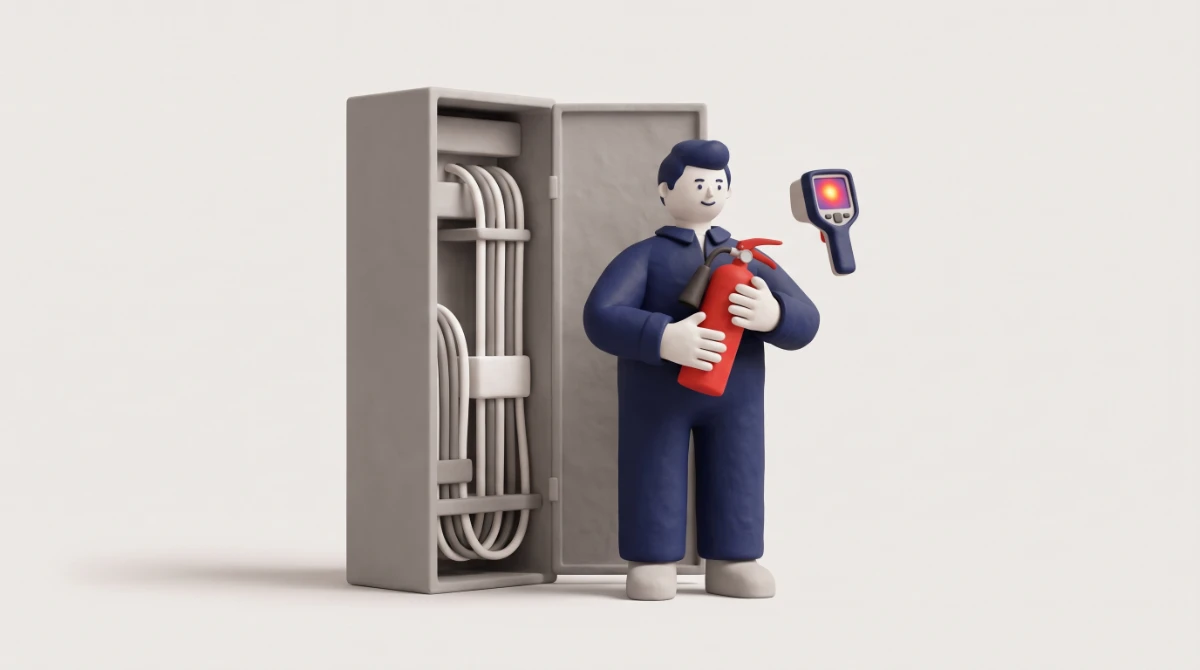
Thermography
Most electrical fires start at a terminal that has been heating up for weeks. Thermography makes the hot spot visible while it is still a repair job and not yet a loss.
Six languages
Section 12 of the German Occupational Safety Act requires that instruction is understood. Anyone who instructs in German and is not understood has not instructed.
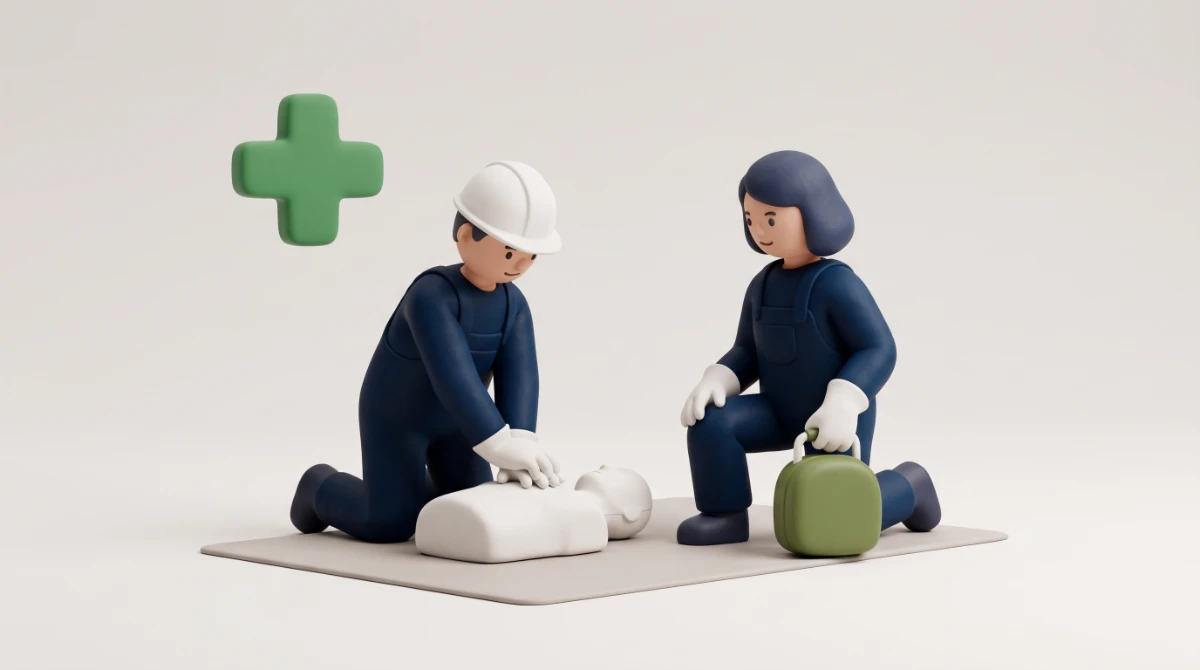
First aid
In a real emergency the first three minutes decide the outcome. So we do not train in a seminar room but where the emergency will actually happen, with realistic casualty simulation, noise, confined space and the colleagues who will have to help.
Find your fit
Every environment has its own inspection intervals and its own record-keeping duties. Pick yours, we will show you what applies.
Choose your environment on the left. We will show you which services apply and what the next step is.
The classic set of operator duties: designated fire wardens, trained first aiders, annual instruction, regular inspection, and a record that exists when someone asks for it.
Section 43 of the German Infection Protection Act applies from day one. Add HACCP, grease fire risk in the kitchen and a team that often does not speak German as a first language.
Short build-up times, many external trades and an authority that wants to see concepts before the first guest arrives. Fire watch and medical cover are part of the permit.
Seasonal staff, changing guests, gas cylinders and long distances to the nearest hydrant. Fire safety and hygiene run in parallel here, and the crew is different every spring.
Structural measures are restricted, so the organisation carries the load. Instruction, inspection and fire safety regulations have to be all the more robust, and agreed with the heritage authority.
Storage, sales floor and seasonal staff who start three days before New Year. The instruction has to land before the goods hit the shelf.
Describe briefly what you operate and which records you have to keep. We will map it and name the next step, without you having to work through the regulations first.
We will map your legal obligations, name the next step and reply within one working day.